
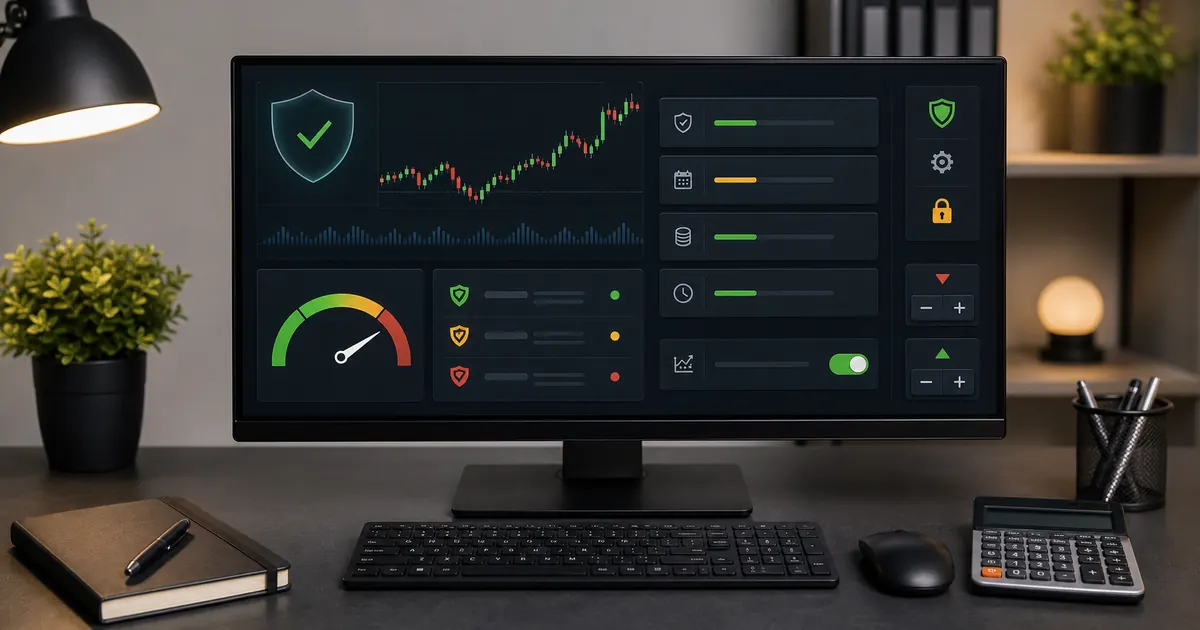
The best risk management strategy for Quotex traders is the one that keeps you trading small, selective, and calm enough to follow your plan. Most traders do not lose their account because they cannot find any winning trades. They lose because one bad session turns into bigger stakes, revenge entries, and recovery attempts that grow faster than the account can handle.
Risk management is not a boring extra. It is the trading system. Strategy decides where you may enter. Risk management decides whether you survive long enough to improve. If you use a Quotex bot, risk settings become even more important because automation can repeat mistakes quickly unless hard limits are active.
Use fixed stake first
Fixed stake is the simplest and cleanest method for most traders. You choose one small trade amount and keep it unchanged during the session. This makes your results easier to understand. If you win five and lose five, you know the strategy is around break-even before payout effects. If you change stake after every trade, your result may be caused by sizing decisions rather than signal quality.
Beginners should avoid risking a large part of the account on one trade. A small stake may feel slow, but slow is useful when you are still learning. Your first goal is not to double the account. Your first goal is to collect experience without emotional pressure.
Set a daily loss limit
A daily loss limit is a hard stop. When the account reaches that loss for the day, trading ends. No exceptions, no "one last trade," and no recovery attempt. This rule protects you from the part of trading that causes the most damage: continuing after your focus is gone.
The daily loss limit should be small enough that you can accept it emotionally. If the limit hurts so much that you immediately want to win it back, it is too large. A good limit allows you to close the platform and return tomorrow with a clear head.
Use a profit target carefully
A daily profit target can also help. Many traders give back profit because they keep trading after a good session. If your plan says stop after reaching a reasonable target, follow it. The market does not owe you more because the first trades went well.
Do not make the target unrealistic. A target that requires too many perfect trades will push you into low-quality setups. A modest target encourages selectivity. Once reached, protect the result and review the session.
Limit consecutive losses
Consecutive losses are a warning. They may mean the market condition changed, your focus dropped, or the strategy is not matching the session. Stop after a set number of losses in a row. Three is a common limit for many short-term traders, but the exact number depends on your plan and risk tolerance.
This rule is especially important for auto trading. A bot should pause after consecutive losses so you can review the chart. Continuing automatically after a losing sequence can turn a normal drawdown into a serious problem.
Be careful with recovery and martingale
Recovery systems increase stake after a loss to win back previous losses. They can look attractive because one win may recover the sequence, but the risk grows quickly. A small losing streak can require a much larger next trade. If that larger trade loses too, the account may be under serious pressure.
If you choose to use recovery, use strict caps. Limit the number of steps, maximum stake, and maximum sequence loss. Never allow unlimited recovery. The phrase "it only needs one win" is dangerous because the market can stay difficult longer than your account can stay funded.
A position sizing example
Suppose a trader has a small account and decides that a bad day should not cost more than a limited amount. The trader chooses a fixed stake that allows several losses before the daily stop is reached. This is much healthier than placing one large trade and hoping it wins. With a fixed stake, the trader can lose, pause, review, and return later. With an oversized stake, the trader often feels forced to recover immediately.
The exact numbers are personal, but the structure should stay the same. Decide the maximum daily loss first, then choose a stake that fits inside that limit. If your daily stop allows only two normal losses, the stake is probably too large. If it allows enough trades to test the strategy without panic, the size is closer to realistic. Good risk management is not about being fearless. It is about making the next decision calmly.
Respect payout
Payout changes the math. A trade with low payout requires a higher win rate to be profitable. This means a weak payout can turn a decent signal into a bad opportunity. Set a minimum payout filter and skip trades below it. If your bot supports payout blocking, keep it enabled.
Many traders overtrade when payout drops because they are focused only on direction. Direction is not enough. The reward must justify the risk. If the payout is not acceptable, waiting is the correct decision.
Create a session plan
Before trading, write the pair, expiry, maximum trades, stake size, daily loss limit, profit target, and stop conditions. This takes less than one minute. It prevents random decisions later. A session plan also gives your bot clear boundaries if you use automation.
After the session, write what happened. Did you follow the plan? Did you stop at the limit? Did you trade because of a setup or because of emotion? Risk management improves when you review behavior, not just profit and loss.
Account protection checklist
- Trade fixed stake until the strategy is proven on demo.
- Use daily loss and profit limits.
- Stop after a small number of consecutive losses.
- Block low-payout trades.
- Avoid unlimited recovery systems.
- Keep a written record of every session.
The best Quotex risk management strategy is simple because simple rules are easier to follow under pressure. Protect the account first. Good entries matter, but survival matters more. When your downside is controlled, you can test, learn, and improve without letting one emotional session decide everything.
Need the full workflow?
Start with referral verification, test on demo, keep risk controls visible, and use the admin dashboard to manage access cleanly.