
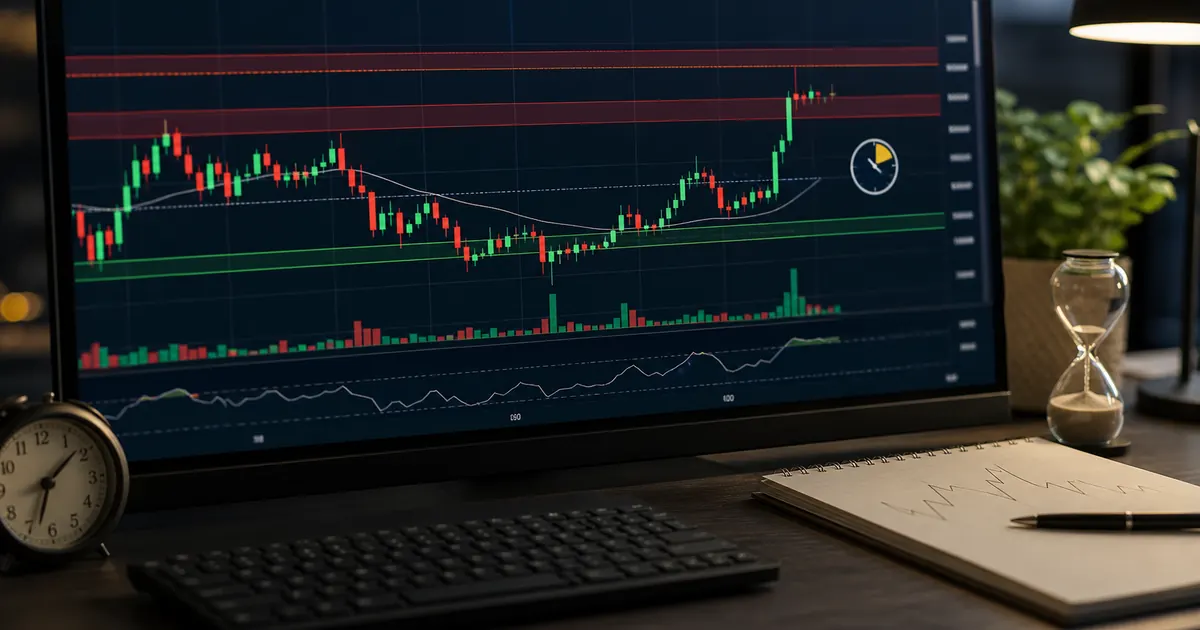
A good Quotex strategy for 1 minute trading must be simple enough to execute quickly and strict enough to keep you out of bad trades. The one-minute chart moves fast, so you do not have time to debate five indicators. You need a repeatable plan: identify direction, mark the nearest level, wait for rejection or continuation, check payout, use fixed stake, and stop when the session limit is reached.
The strategy below is designed for traders who want practical rules, not magic. It can be used manually or with a bot that supports MT5 analysis and signal filters. It will not win every trade. No 1-minute method does. Its value is that it removes random entries and makes your trading easier to review.
The market condition filter
Before looking for entries, decide whether the market is trending or ranging. On MT5, look at the last 20 to 30 candles. If price is making higher highs and higher lows, the short-term bias is up. If it is making lower highs and lower lows, the bias is down. If price is moving sideways between two levels, treat it as a range. This first step prevents you from taking a reversal trade in the middle of a strong push.
For beginners, the safest rule is to trade with the short-term direction unless price reaches a clear support or resistance level. In an uptrend, look for call trades after pullbacks. In a downtrend, look for put trades after pullbacks. In a range, look for rejection from the edges, not entries in the middle.
The level rule
Every 1-minute trade should happen near a reason. That reason is usually a previous high, previous low, support area, resistance area, or a clean breakout retest. If the signal appears in empty space, skip it. Levels matter because they show where traders recently reacted. A candle signal away from a level is often just noise.
Mark only the nearest useful levels. Do not cover the chart with lines. Too many lines create hesitation. A practical setup has one resistance above, one support below, and the current trend direction. If price is trapped exactly between support and resistance, wait. The best trades often come after price reaches an edge and shows rejection.
The candle confirmation
For a call trade, look for a rejection candle from support, a bullish close after a pullback, or a breakout retest that holds. For a put trade, look for rejection from resistance, a bearish close after a pullback, or a failed breakout. The candle should close with intent. Avoid entering while the candle is still forming wildly because the shape can change before close.
Wicks are useful, but context matters. A long lower wick at support can support a call trade. A long upper wick at resistance can support a put trade. A wick in the middle of a range means less. Combine wick behavior with location and trend direction.
Expiry and timing
For 1-minute trading, expiry should match the candle speed. If price is moving normally, a one-minute expiry can work with the next candle continuation. If candles are extremely fast, you may get late entries and poor fills. If candles are too small and flat, there may not be enough movement before expiry. This is why a volatility filter matters.
Do not enter immediately after a large news candle. A big candle may look attractive, but the next minute can be unpredictable. Wait for price to settle and form a readable structure. Missing a trade is better than entering during chaos.
Rules for the actual entry
- Trade only one selected pair during the session.
- Use the trend or range filter before every entry.
- Enter only near a marked level or clean retest.
- Require candle confirmation before the trade.
- Skip trades when payout is below your minimum.
- Stop after your daily loss limit or consecutive loss limit.
These rules sound strict because they should be. One-minute trading punishes loose behavior. The fewer random trades you take, the easier it becomes to see whether the strategy has real value.
How to use a bot with this strategy
If you use a Quotex trading bot, configure it to support the same logic. The bot should read MT5 trend context, detect levels or at least recent highs and lows, filter weak candles, and block trades when payout is too low. It should also have a cooldown so it does not enter multiple times on the same movement.
Start in signal-only mode. When a signal appears, compare it with your manual strategy rules. If the bot signals in the middle of nowhere, adjust filters or skip that pair. If the bot consistently finds pullback entries near levels, continue demo testing. The bot should support your strategy, not force you to abandon it.
Money management for 1-minute trades
Use fixed stake. This is the cleanest way to judge the strategy. If you change stake size after every result, your account curve tells you more about emotion than strategy. A beginner can risk a very small percentage of the account per trade. The goal is to survive enough trades to collect useful data.
Set a session limit. For example, stop after 10 planned trades, two wins in profit, or three losses in a row. A short session limit keeps you from forcing trades when the best setups are gone. The most underrated part of a 1-minute strategy is knowing when to close the platform.
Review process
After each session, take screenshots of good trades, bad trades, and skipped trades. Write one sentence for each: followed rules, entered late, ignored level, payout too low, or market too messy. After a week, patterns will appear. You may find that one pair works better, one session is cleaner, or one setup causes most losses. That review is where improvement happens.
The best Quotex strategy for 1 minute trading in 2026 is not a secret indicator. It is a disciplined process built around trend, levels, candle confirmation, payout, and risk. Keep it simple, test it on demo, and make the bot follow the rules instead of letting automation create new risks.
Need the full workflow?
Start with referral verification, test on demo, keep risk controls visible, and use the admin dashboard to manage access cleanly.